
BLSA
Bulletin
BLSA Bulletin | 20th Edition
Introduction
Welcome to the 20th edition of the BLSA Bulletin. It has been a demanding few months for South Africa’s reform programme, and this edition reflects both the breadth of BLSA’s engagement with government and other stakeholders. It also reflects the scale of what remains to be done.
On transformation, the proposed amendments to the B-BBEE Codes of Good Practice carry real unintended consequences, from a structural arithmetic error in the procurement scorecard to the absence of a transition period for existing contracts, and BLSA and BUSA took these concerns directly to Minister Parks Tau and the dtic. We also made a submission on draft General Public Procurement Regulations, which reshape roughly R1 trillion of annual public spending without a published economic impact assessment. In both cases, our position has not been to oppose the intent of transformation, but to insist that the mechanics work, and that the burden of compliance is one the economy can carry.
Local government also demanded sustained attention. The Reviewed Draft White Paper on Local Government is the most substantial reform of that framework since 1998, and BLSA’s input, welcoming the direction of travel while flagging the implementation and financial risks, has helped shape the latest draft. This work sits alongside our continued technical support to Operation Vulindlela, where rail, water and visa reforms are moving from policy design into implementation, even as the fourth BLSA Reform Tracker showed our overall reform completion index slip slightly, a reminder that momentum must be maintained.
On the international front, this has been a period of real turbulence. The USTR’s 12.5% tariff under the Section 301 investigation, AGOA’s uncertain modernisation, and shifting global trade rules all featured heavily in our engagement with BUSA and government. Encouragingly, our SA-UK Digital Trade Business Dialogue in August pointed to where new opportunity lies: digitally delivered services already account for close to half of our services trade, and there is real scope to unlock more of it if we address the regulatory friction that still holds South African firms back.
Energy and water reform, meanwhile, continue to move, albeit unevenly. From the National Water Amendment Bill to NERSA’s work on electricity tariff structures and the SA Wholesale Electricity Market, business has stayed closely engaged, because these are the enablers on which everything else depends.
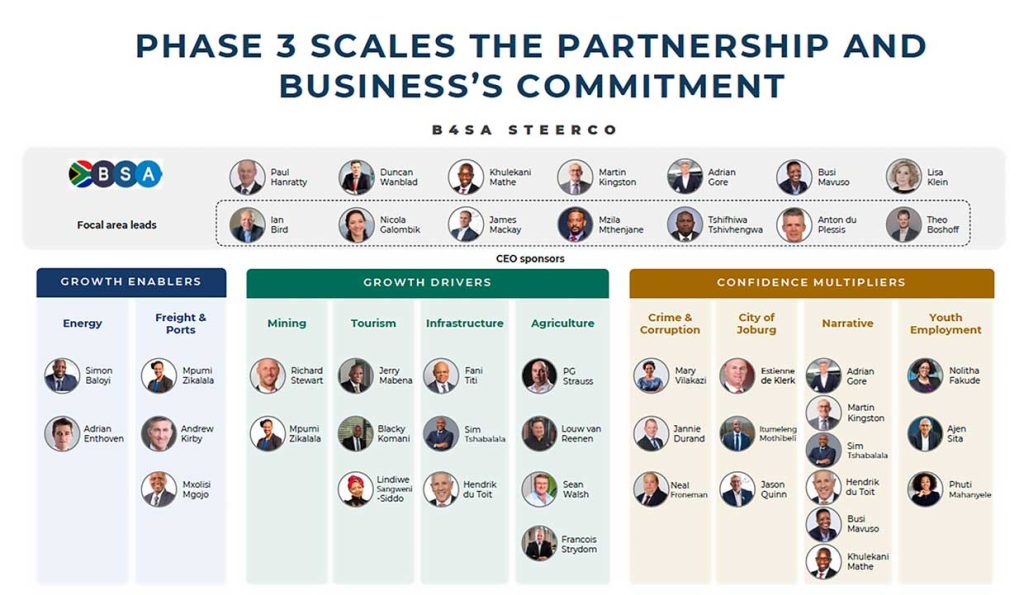
I want to close on a development that captures why I remain genuinely optimistic about where South Africa is heading. At the time of writing, phase three of the business-government partnership had just been launched. Over 30 CEOs have volunteered their time, capacity and resources to work alongside President Ramaphosa, cabinet ministers and senior government leaders on the task of growing our economy by more than 3% a year, the level at which unemployment can finally start to fall in a meaningful way. The first two phases of this partnership delivered real results: over R360 billion invested in new energy generation, and more than R20 billion committed to port and rail infrastructure. Phase 3 marks a shift in emphasis, from fixing what was broken to unlocking the growth that our reforms have made possible, focused on mining, agriculture, tourism and infrastructure, and on the confidence multipliers of crime, corruption and a credible national narrative.
I am proud of what business, including many of our members, continues to bring to this partnership, and confident that if we hold each other to account on delivery, the opportunity ahead is real.
Sincerely
Busisiwe Mavuso
CEO, Business Leadership South Africa

Strategy and Reforms Update

Structural Reforms
Business Leadership South Africa (BLSA) continues to provide technical support to Operation Vulindlela (OV) to accelerate the implementation of pro-growth structural reforms. This support aligns with OV’s current reform agenda, which is focused on improving economic performance through greater private sector participation and enhanced regulatory frameworks.
Priority Reform Areas
Operation Vulindlela’s overarching objective in phase 2 is to drive improvements through liberalisation and increased private sector participation in the following sectors:
- Energy
- Logistics
- Water provision and quality
- Visa reform
- Local government and service delivery
- Urban renewal
- Digital transformation
Key Outcomes Achieved so far in 2026
Rail Reform
- Publication of Version 4 of the Rail Reform Network Statement
- Finalisation of an updated Rail Access Agreement
- Enactment of the National Water Resource Infrastructure Agency (NWRIA) legislation and appointment of its board
- Allocation of rail network slots by the Transnet Rail Infrastructure Manager (TRIM) to train operating companies (TOCs), together with the conclusion of rail access agreements
- Issuance by Transnet of a Request for Proposals (RFP) for its Rolling Stock Leasing Company (LeaseCo) to two shortlisted bidders selected from 14 respondents to the 2025 Request for Qualifications.
Visa Reform
- Cabinet approval and publication of the Revised White Paper on Citizenship, Immigration and Refugee Protection covering visa categories related to skilled workers, corporate transfers, and start-ups.
Technical Support Facility and Expert Advisory Work
Operation Vulindlela has concluded a contract with the National Business Initiative (NBI), which administers the Technical Support Facility (TSF). Contracting with Genesis has also been completed to support local government reform initiatives, particularly those linked to energy and water reforms.
Competition and Regulation Workstream
A specialist advisor has been engaged to support:
- Development of the National Rail Bill to introduce greater competition in the rail sector
- Establishment of the Transport Economic Regulator under the Economic Regulation of Transport Act
- Creation of an Independent Economic Regulator for Water, including the development of a regulatory roadmap
- Advice on regulatory design, institutional governance and economic regulation models across several reform areas.
Water Sector Reform
A dedicated water reform expert is supporting:
- Development of water sector policy and governance reforms (National Water Action Plan drafted).
Local Government Reform
Support has also been provided in drafting sections of the White Paper on Local Government Reform and the associated Cabinet briefing documents. Key proposals include:
- Abolition of the two-tier district municipality model
- Mandatory lifestyle audits for elected office-bearers
- Performance agreements for mayors and mayoral committees
- Minimum competency requirements for municipal leadership
- Establishment of a statutory professional body for municipal managers, with authority over entry standards and disciplinary processes
- Measures to address municipal fiscal challenges, including replacing declining fuel levy revenues with an origin-based VAT-sharing mechanism.
BLSA Programmes
BLSA council meeting: The Economic Risks facing the City of Johannesburg; Update on B20 Legacy Initiatives
As part of the joint initiative by BLSA, BUSA and B4SA to highlight Johannesburg City’s decline and demonstrate the commitment of business to supporting its recovery, Lael Bethlehem, a Partner at Genesis, was invited to present an analysis of Johannesburg’s financial and operational challenges, highlighting the potential economic impact of a further decline on the city and the national economy.
This was preceded by a presentation on B20 legacy priorities by B20 Sherpa, Cas Coovadia, outlining progress from South Africa’s B20 leadership and the need to sustain reform momentum beyond the G20 presidency.
More than 45 BLSA members attended the event, representing industries such as financial services, FMCG, and automation.
NATJOINTS briefing on Preparedness for Planned Activities around 30 June protests
Over 100 members of BLSA and BUSA, from a range of sectors (including mining, financial services, manufacturing and telecommunications) received an update on the coordinated efforts between the South African Police Service and private security providers, to ensure public safety and respond to any incidents of intimidation, violence, or criminal activity during the protests. The briefing provided businesses with important reassurance that lessons had been learned from the unrest of July 2021, and that government, law enforcement, and security partners had measures in place to maintain stability and address any potential disruptions.
BLSA Reform Tracker
The fourth BLSA Reform Tracker update released on 23 July 2026, showed a decline in South Africa’s reform completion index to 71.5 from 71.7, marking the first loss of momentum due to negative regressions in the electricity and logistics sectors. However, some areas like visa reforms showed progress. The results were released during an online meeting attended by members, media and other stakeholders.
Following the third tracker update on 23 April 2026, a social media campaign was launched the following month to broaden awareness and understanding of key reforms and why they matter, while creating a positive association between the BLSA brand and reform progress, and drive traffic to the Reform Tracker website. The campaign provided a snapshot of reform developments across the economic, criminal justice and governance sectors, using BLSA Reform tracker updates.
Supported by paid promotion, between May and June the campaign delivered approximately 950,000 views across promoted platforms, with meaningful audience engagement and interest in South Africa’s reform agenda.
Economic Policy

B-BBEE Codes of Good Practice
Following BLSA’s written submission to the dtic on the proposed B-BBEE Codes amendments (reported previously), BLSA and BUSA wrote a joint letter to Minister Parks Tau requesting an opportunity to present the unintended consequences identified in their submissions ahead of the amendments being finalised, covering:
the scoring differential favouring Transformation Fund contributions over direct Enterprise and Supplier Development (ESD) spend; the absence of governance and accountability mechanisms for the Fund; a structural arithmetic error in the procurement scorecard (sub-targets aggregating to approximately 134% of the measurable base); the absence of a transition period for existing contracts; and broader real-economy and employment risk from involuntary B-BBEE level drops. The requested meeting took place in early June 2026, with the Department, BUSA and BLSA in attendance, where the business delegation presented on the unintended consequences of the proposed amendments. We await feedback from the department on further developments around this area.
Draft General Public Procurement Regulations, 2026
National Treasury published the draft General Public Procurement Regulations, 2026 on 16 April 2026, giving effect to the Public Procurement Act, 2024. The comment deadline was extended from 15 June to 15 July 2026.
BLSA’s key concerns are that the Regulations reshape roughly R1 trillion of annual public spending without a published cost or impact assessment; that the preferential procurement targets, as drafted, do not add up (set-aside targets across categories sum to well over 100% of the procurement budget) and rely on an ownership threshold that has fared badly in the courts before; that the Regulations carry a retrospective effect, requiring businesses to demonstrate historical subcontracting to B-BBEE entities at levels of up to 30%, which poses compliance and legal difficulties for companies that did not historically meet these targets; and that the compliance and Information and Communication Technology (ICT) demands assume a level of municipal capacity that does not exist.
BLSA finalised and submitted its position on the draft General Public Procurement Regulations to National Treasury by the 15 July deadline.
Sectoral Input on the Impact of Rising Fuel Costs
Following the closure of the Strait of Hormuz and the resulting rise in fuel costs, BUSA requested sector-specific input for a proposal to the dtic. BUSA’s own proposal calls for a strategic fuel reserve framework and phased mitigation strategy:
South Africa currently holds only 7.7-8 million barrels of strategic crude (roughly two to three weeks of supply, against the International Energy Agency’s 90-day benchmark for member countries), refining capacity has halved since 2020 and around 67% of fuel imports flow through a single point of entry at Durban’s Island View. BUSA further proposes finalising the long-outstanding Strategic Stocks Petroleum Policy, strengthening storage and logistics infrastructure and phased short, medium and long-term measures including a Fuel Price Stabilisation Fund modelled on India. BLSA submitted supplementary input received in the Fast-Moving Consumer Goods (FMCG), automotive/transport logistics, mining and banking sectors.
AGOA Modernisation and USTR Section 301 Forced Labour Finding
BUSA made a formal submission directly to the office of the United States Trade Representative (USTR) on AGOA modernisation and engaged with the dtic on the Section 301 forced labour finding on behalf of organised business. Following the USTR’s announcement of a 12.5% tariff on South African goods on 23 July 2026, BLSA will continue to monitor developments.
SA-UK Digital Trade Business Dialogue (6 August 2026)
The UK government, the dtic BLSA and BUSA co-hosted a public-private dialogue on SA-UK digital trade.
The dialogue drew on IEP-funded research, ‘Options and Opportunities for Enhancing Digital Trade between SA and the UK, conducted by DNA Economics and ODI Global. The research found that digitally delivered services (services supplied across borders through digital platforms) account for 45% of South Africa’s total services trade and 67% of the UK’s, and that the UK is South Africa’s second-largest services trading partner, accounting for approximately 10.5% of South Africa’s total services exports in 2023.
It found strong alignment between the African Continental Free Trade Area’s Digital Trade Protocol and the UK’s approach to digital trade agreements on core issues such as cross-border data flows and source code protection. However, it also identified practical barriers limiting South African firms’ ability to scale into the UK market:
- Exchange control complexity in extracting foreign currency earned through services exports;
- Fragmented data protection regimes (South Africa’s Protection of Personal Information Act (POPIA) and the UK’s General Data Protection Regulation (GDPR)) requiring parallel compliance programmes;
- Diverging e-invoicing timelines;
- Weaker domestic intellectual property enforcement;
Professional licensing requirements for services such as law, architecture and accounting;
Low market awareness (a survey of 42 UK Chief Information Officers (CIOs), conducted as part of the research, found only 15% aware that South Africa has a growing technology sector).
The dialogue, held at BLSA’s offices on 6 August 2026 in hybrid format, shared evidence between government and the private sector on barriers to and opportunities for bilateral digital trade, compared existing UK and South African initiatives, and identified priority domestic regulatory reforms and options for deeper bilateral collaboration.
Social Policy

Reviewed Draft White Paper on Local Government
CoGTA published the Reviewed Draft White Paper on Local Government (WPLG) for comment by 28 May 2026. It is the most substantial review of the local government framework since 1998, running to 124 pages and approximately 65 policy proposals covering municipal restructuring and a longer-term move to a single-tier system, depoliticised administration, financial sustainability and strengthened public participation.
BLSA consolidated member comments, welcoming the direction of reform (particularly private-sector partnerships) while raising the following:
- The economic cost of municipal dysfunction is not quantified anywhere in the White Paper.
- Implementation capacity risk: several proposals assume administrative and technical capacity that most municipalities do not have.
- Financial exposure: Eskom-related municipal debt stands at approximately R110 billion, against total municipal and consumer debt of approximately R467 billion.
- Risk that municipal mergers and boundary reconfigurations may transfer existing governance and capacity failures into larger municipal structures without addressing their root causes.
- Skills and capacity constraints in rural municipalities, and the role of traditional leadership, remain inadequately addressed.
The White Paper, taking into account additional comments received, was targeted to reach Cabinet by end of July 2026 for consideration. BLSA continues to monitor its progress.
BUSA withdrawal from Nedlac UIF Structures
On 1 July 2026, BUSA withdrew from the Unemployment Insurance Fund (UIF) structures at Nedlac and removed its representatives from the UIF Board, citing six years of unresolved warnings over maladministration, governance failures and a lack of progress on a Nedlac task team it called for in 2024.
BUSA has called on the Minister of Employment and Labour to place the UIF under administration, with an independent administrator to stabilise operations and clear claims backlogs and a forensic investigation into Fund expenditure. BLSA will continue to monitor the Minister’s response and BUSA’s guidance on next steps for organised business.
Employment Equity Amendment Bill, 2026 ('Fair Pay Bill')
Nobuntu Hlazo-Webster, a Member of Parliament (MP), published a Notice of Intention to introduce the Employment Equity Amendment Bill, 2026 (‘Fair Pay Bill’) as a Private Member’s Bill, proposing a ban on employers requesting or relying on salary history during recruitment, mandatory pay transparency (including disclosure of remuneration ranges for vacancies, promotions and transfers), and a right for employees to request and share remuneration range information.
BLSA submitted inputs via BUSA. BUSA’s submission does not oppose the policy objective but raises five concerns: the salary history ban is overly broad and could criminalise routine Human Resources (HR) benchmarking; mandatory pay transparency imposes a disproportionate compliance burden, particularly on Small, Medium and Micro Enterprises (SMMEs); the Bill duplicates protections that already exist under section 6(4) of the Employment Equity Act and the 2025 Employment Equity Regulations; the enforcement and liability framework is unfunded and would add to an already backlogged Commission for Conciliation, Mediation and Arbitration (CCMA); and the Bill was introduced without prior Nedlac consultation, contrary to established tripartite practice. BUSA has called for the Bill to be referred to Nedlac before it proceeds further. BLSA will continue to monitor the Bill’s progress through Parliament.
Energy and Environment

Water: National Water Amendment Bill
Parliament’s Portfolio Committee on Water and Sanitation called for public comment on two bills: the National Water Amendment Bill, which seeks to ensure more equitable water allocation, prohibit private water trading, and strengthen protection of strategic water source areas; and the Water Services Amendment Bill, which strengthens the Department of Water and Sanitation’s powers to act against underperforming Water Services Authorities. BLSA made a submission on the National Water Amendment Bill, via BUSA.
NERSA Draft Market Inquiry Report on Electricity Distributor Charges
NERSA published its Draft Market Inquiry Report on the impact of fixed charges and Generation Capacity Charges (GCC) levied by electricity distributors and invited public comment by 27 July 2026.
The inquiry examines concerns that recent tariff restructuring, including fixed charges and Eskom’s GCC, has resulted in electricity cost increases exceeding approved tariff increases, with implications for affordability, transparency and cost reflectivity. This is an important consultation for business, given its potential influence on future electricity tariff structures, costs, investment decisions, competitiveness and the implementation of the South African Wholesale Electricity Market (SAWEM). BLSA submitted member input to BUSA on the market inquiry.
National Rail Master Plan and SANPC Bill
The Department of Transport (DOT) published the Draft National Rail Master Plan for public comment, setting out a long-term vision for a modern, efficient rail network integrating freight and passenger corridors and aiming to attract private-sector investment through concessions. Separately, Parliament’s Portfolio Committee on Mineral and Petroleum Resources invited written comment on the South African National Petroleum Company (SANPC) Bill, which establishes the SANPC as a state-owned petroleum entity consolidating iGas, the Strategic Fuel Fund and PetroSA. BLSA circulated both for member comment.
NERSA Section 29 Consultation: Municipal Electricity Reticulation KPIs
On 29 June 2026, NERSA released a consultation paper and draft rules under section 29 of the Electricity Regulation Act, proposing Key Performance Indicators (KPIs) for municipal electricity reticulation systems covering network reliability, distribution losses and payment of bulk electricity accounts. While this does not address the underlying structural challenges facing municipalities, it introduces a framework to measure and improve their operational performance, and is significant given that reliable, financially sustainable municipal distributors are essential for SAWEM’s efficient operation. BLSA circulated the consultation for member comment.
Draft 10th National Greenhouse Gas Inventory Report
The Department of Forestry, Fisheries and the Environment published the draft 10th National Greenhouse Gas Inventory Report on 29 May 2026 for public comment, which will feed into South Africa’s Second Biennial Transparency Report to the United Nations Framework Convention on Climate Change (UNFCCC). The report completes the 1990-1999 time series and covers emissions from 1990-2024; energy remains the dominant contributor at 78.6% of national emissions in 2024 (84.5% including land use, land-use change and forestry). BLSA’s input fed into BUSA’s submission.
EU Workshop: Implications of CBAM for South African Industry
BLSA attended a workshop hosted by the Delegation of the European Union to South Africa on 28 May 2026, on the implications of the EU’s Carbon Border Adjustment Mechanism (CBAM) for South African industry. CBAM entered a new phase on 1 January 2026, moving from reporting obligations to a system imposing a financial liability on carbon-intensive imports into the EU.
South Africa’s current exposure is limited: CBAM-covered products made up approximately 6% of South Africa’s exports to the EU in 2024 (iron and steel around 3.3%, aluminium around 2.8%), and only direct (Scope 1) emissions are currently counted for these products, meaning Eskom’s coal-heavy grid does not yet factor into exporters’ liability.
However, two developments could materially widen this exposure: a European Commission proposal (December 2025) to extend CBAM to roughly 180 downstream product categories, including machinery, vehicle components and fabricated metal products, in which South Africa is a significant EU exporter; and a scheduled 2027 review of whether to extend liability to indirect (Scope 2) emissions for iron and steel, aluminium and hydrogen, which would bring Eskom’s carbon intensity directly into exporters’ cost base. South Africa’s low effective carbon tax (estimated at $0.30-$2.60 per tonne CO2e, against EU carbon prices that have often exceeded $60) also limits the relief available to exporters through CBAM’s carbon-cost deduction mechanism. BLSA will continue to monitor the EU’s downstream-product and indirect-emissions review process and the domestic carbon tax debate this is likely to reignite.